When Peggy Met Stracey – A family memoir
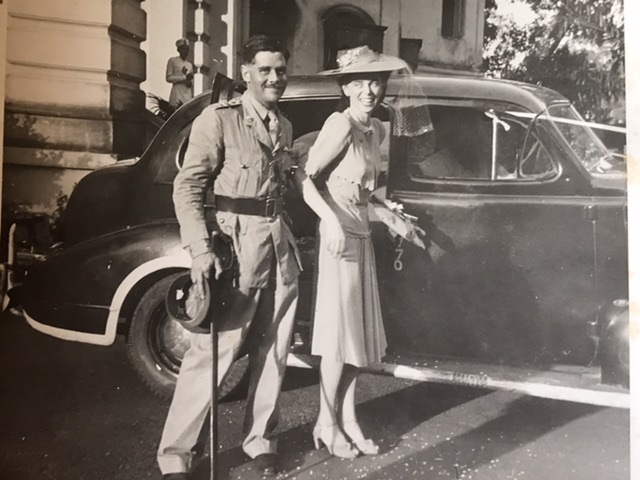
In 1942 a dashing ex-RAF pilot serving with the Indian Army married his commanding officer’s pretty 20-year-old daughter in St. Paul’s Cathedral, Calcutta. They were two of your great-grandparents. Here’s the story of how Peggy met Stracey.
Stracey
1. Going for a Burton – Leicestershire, 1938
2. A christening – Penn, 1913
3. The King of Italy – Valparaiso 1862
4. The Sinking of the Sandringham – Mauritius, 1865
5. Booze and Bad Business – St John’s Wood, London 1918 6. Babs and Frau Hitler – Weston-super-Mare, 1920
7. A Good Thrashing – Sherbourne, 1931
8. Sherry, Sir? – Osbaston Hall, 1938
Peggy
1. Mother India – Nainital 1922
2. First Night Nerves – The Somme, 1915
3. Tikki and the Snake – Allahabad, 1925
4. The Second Born – Matana, Sri Lanka, 1898 5. Tombstones and Monuments – Jaffna, 1912 6. ‘D’you paint?’ – Poole, 1935
7. ‘I lost my Albert’ – Clevedon, 1935
8. John Borie’s Deceit – Philadelphia, 1808
India
1. Lost with the elephants – Burma, June, 1942
2. Troubles with trousers – Peshawar, March 1939
3. Spice, shit and flowers – Peshawar, September 1939 4. Bad Language – Peshawar, November 1941
5. Love on the North Circular – Peshawar, March 1941 St Paul’s Cathedral, Calcutta XXX 1942
Stracey
1. Going for a burton – Leicestershire, 1938
You can’t mistake the sound of a Westland Wallace. Unlike its chummily-named predecessor, the Westland Wapiti, the Wallace’s fuselage-mounted, two-blade, wooden propeller mounted on a 680 horse-power, air-cooled, Bristol Pegasus IV engine, produced a roar like a rowdy fart. Brrrrrrrrrrrrrrrrrrrrrrrrarrurp.
The Westland was a biplane, about the size of a bus. You needed a wooden stepladder to mount the open-air cockpits for the pilot and observer. And a ground crew to steady the ladder, hand-crank the engine and, after a thumbs up from you, heave away the chocks. There were no brakes. Once the Rolls Royce tyres were rolling, the Wallace bounced across the turf and, with a surge of power, mounted the skies like an oversized bumble bee. Brrrrrrrrrrrrrrrrrrrrrrrrarrurp.
Two Wallaces broke the world aviation height record in 1933 when they flew over Mount Everest. But now it’s 1938 and there’s a Wallace growling through the skies over Osbaston Hall in Leicestershire. Brrrrrrrrrrrrrrrrrrrrrrrrarrurp. Look up and you can see the pilot in his fur-lined flying jacket and leather helmet peering over the side through froggy goggles.
It’s Leading Airman Howard Stracey Laws and he’s gripping the joystick as if someone’s trying to steal it.
He looks anxiously at his flight instruments. They’re the standard six-pack: altimeter, airspeed, turn indicator, bank indicator, artificial horizon and directional gyro. Keep these sweet and the Wallace stays airborne. Just now, however, altimeter and airspeed are falling fast. And there’s a smell of burning oil.
The bloke behind, the observer, has a pair of black Bakelite headphones clamped over his helmet. Radio operator Rees. (We don’t know his other name. Like public schoolboys, aircrew only use surnames.) He can smell the fumes too.
– Rees!
Laws bellows into the brass mouthpiece by his side. A canvass tube carries his voice back.
‘Spot of bother. Bringing her down.’
‘Right-oh, sir.’
Rees looks over the side. The earth is shit brown, hedged, fielded, farmed. Someone is harrowing with a pair of horses. There’s no airfield. Rees is nervous, but he trusts Laws. A stickler for procedures (‘Cockpit drill, Rees. Never omit your cockpit drill’), Laws handles the Wallace with concentrated confidence.
‘Prang sir?’ ‘‘Fraid so.’
The chubby little pilot officer is a seasoned staffer with No 5 (Bomber) Group based at RAF Grantham. Earning a generous eighteen shillings a day, he’s the personal pilot of the station’s boss, Air Officer Commanding William Callaway. And unlike Callaway (who Laws describes as ‘dauntingly sober’) the leading airman spends a lot of his money on beer.
Laws was the RAF’s youngest pilot at the time he joined in September 1931. When he pays his final mess bill and quits the RAF for India in March 1939, he will have clocked up 2,000 flying hours, served at RAF stations Filton, Oxford, Bircham Newton, Hendon and in the desert at Sudan. And – spoiler alert – survived three crashes.
So long as you didn’t mind heights, it’s a good life being a bachelor in the blues. Blues like prang, bellyflop, or going for a Burton, is RAF slang. Prang was Malay for going to war; Burton’s was a famous Midland brewery; and the blues were the wedgewood-blue uniforms that set the RAF apart from pongos (soldiers) and skates (sailors). You wore your best blues on parades or for formal mess dinners, but you flew in your battle blues. Your battle blues were given to you free by the RAF along with an aeroplane. But the price of your best blues came out of your own pocket. Stracey bought his from Saville Row, the London street where all the top tailors worked. Naturally he collected them by ‘plane.
Another pilot ‘borrowed’ one of the trainer Gloucester Gladiators when Stracey was training at RAF Filton near Bristol, and the pair flew to RAF Hendon near London. Stracey hopped in a taxi to collect his new uniform from Saville Row while his pal nipped off to meet a girlfriend. By the time the pair headed back to Bristol it was dangerously dark and they were forced to fly low so they could follow the thin gleams of silver below, the Great Western Railway tracks, back to Bristol.
The blues, like the trademark red, white and blue roundels painted on Laws’ aircraft, were the brainchild of a tall, fierce-looking First World pilot with a broken nose, Hugh Trenchard. Trenchard was (more slang) big brass and, as Chief of Air Staff, fought paper battles with jealous rivals in the Army and Navy who considered the RAF above itself, literally and metaphorically.
Shortly after joining the RAF Laws heard Trenchard give a speech inside a cavernous hangar at Filton. Trenchard glared at the mass of young pilots in front of him.
‘You are embarking on a career intended to turn you, not into mere aerial chauffeurs, but experts in meteorology, navigation, photography and wireless,’ he began.
‘You’ll have the loyal support of an army of technical people, boy apprentices straight from school. They will be less well educated than you. Treat them with respect – my expensive aeroplanes, and your lives, depend on them.’
Stracey was growing bored by the man the Americans hailed as ‘the patron saint of air power’. He’d just decided to stop shaving his upper lip and grow a delta-winged, moth-like moustache like Trenchard’s when he heard the Air Chief Marshall say ‘… which brings me to the matter of flying accidents. There are too many. And they must be eliminated.’
Courteously thanking his audience Trenchard stepped down and, surrounded by a posse of senior officers covered in scrambled egg (gold braid), strode out into the sunshine. Ten years later a horde of Trenchard’s ‘expert pilots’ would rise into the heavens like a swarm of wasps and succeed in killing enough of the enemy to win the aerial Battle of Britain. Laws wasn’t there. By then he was teaching Pathans to drive motorcycles in the desert outside Landi Kotal having, as you may have guessed, let Trenchard down over the matter of aerial accidents.
2. A Christening – Penn, 1913
Who was Stracey Laws?
The youngest of Ada Laws’ seven children, he was born in what he called the ‘royal’ county of Buckinghamshire on June 5 1913. The bawling baby was carried to the stone font in Penn village church by a gaunt, bearded rector, the Reverend Mr Kirby, who christened him Howard Stracey Laws.
Strace, as he was known ever afterwards (and as we shall call him from now on), was wheeled home in a high pram seated alongside his older brother George. Pushing the pram, and ignoring the wolf whistles from the farm hands cutting a hay
meadow, was his nursemaid Miss Batter. Her companion, the children’s governess Mildred Small, bobbed her hair self consciously and hurried along her other charges: Thurlow (11), Barbara (10), Winifred (8), Kingsley (7) and Bollin (5).
The procession was headed by their parents, Ada and Robert Laws, along with Robert’s mother, Polly. Robert, better known as Bob, was frowning. Shepherding the household into the family pew at Holy Trinity church earlier, he had smiled at the family in the neighbouring pew, the Macleans (their little boy, Donald, would grow up to be a famous British spy), then scowled at his own children. Back at home, the seven-bedroomed Penn Lodge that boasted a large garden, two cars and a staff which included chauffeur/gardener Moses White, Bob examined the children over his steel-rimmed glasses with distaste.
Bob was a wirey little man, rarely seen without a fag in one hand and a tot of whisky in the other. Usually dressed in dark tweed jacket, waistcoat and knickerbocker trousers, he was religious (breakfast was always followed by family prayers), strict, and frequently as unreasonably furious with his children as he was with his wife.
On Monday mornings he’d glare at his offspring before being driven by Moses, in either the 1911 Wolseley Tourer or the open, two-seater Belise, to Beaconsfield Station. Growling a good morning at the Station Master he’d take his usual seat in the First Class carriage, snap open his Times, ironed earlier by Miss Batty and, ignoring his fellow passengers who usually included their neighbour, the novelist G. K. Chesterton, read it until the train reached Paddington, London.
Businessman Bob looked every part the successful financier: stern, sure and taciturn. And yet, if you could have sneaked a look at the italic entries under the pounds, shillings and pence columns of his private notebook, you’d realise the old boy was, like his son over Leicestershire 25 years later, heading for a Burton.
3. The King of Italy – Valparaiso 1862
He’d been born on September 16 1868 to Master Mariner Thomas Laws and his wife Mary Ann Bollin. She didn’t care for the name Mary Ann and called herself Polly or Marion. (We’ll stick to Polly and yes, that was her 45 years later, sweeping along in her habitual widow’s black after Strace’s christening).
Tom and Polly lived in a cramped terraced house, 45 Albert (now Alberta) Street, Newington, a rough part of Kennington in south London. The streets were mean, narrow and swirling with those city smells that characterised Victorian London: offal,
refuse and a hint of sewage. Close by was the Newington, a spit-and-sawdust inn where Tom, when ashore, supped his pint of porter and reflected on his short, but memorable life to any market porter or coster who’d listen.
He’d describe how he’d been born in March 1826, the son of Norfolk grocer George Laws and the youngest of George’s wife Clementina’s (nee Mingay) six children. And he’d tell them how he’d hated weighing slices of stinky bacon and parcelling up packets of dusty tea in George’s shop. Instead he’d attended evening classes in maritime law, compass work and all things nautical to escape retail drudgery. He went to sea and by October 1867, the 24-year-old had qualified as Ship’s Master.
He had by then already experienced some memorable journeys. The most dramatic was aboard a tea clipper, the King of Italy. The King was a 1,363 ton, streamlined, full-sailed, three-master merchant ship. She was built for speed. Well-crewed and with good weather, her bow could slice the customary four-month journey between London and Melbourne in half.
The shipping correspondent for the New Zealand Herald described her as ‘a noble ship’ when she hove to in the Hauraki Gulf in 1865. The King and its 216 British passengers were temporarily stranded offshore by a case of ‘choleraic diarrheae’. Notwithstanding this, she’d enjoyed a relatively easy journey from England, according to the ship’s surgeon who told the correspondent they had lost ‘only three infants’, one from bronchitis, during the passage.
Tom Laws disliked the King. Three years earlier he was serving as her 2nd Officer on a return journey from Melbourne to England. She was, he wrote later, ‘not quite so seaworthy as we could have wished’.
He had counted in ‘73 souls on board . . . amongst them eight women and 16 children, four of whom were in arms and the eldest of the rest about 16 years’ at the start of the journey. They all took fright when the King hit a storm and her deck seams began to ‘open out very much with every roll.’ Each time she heaved over, seawater sloshed across the decks and poured between the boards, into the hold below which was packed with bales of Australian sheepskins.
When wool is wrapped tight then wetted, the resulting anaerobic activity can generate intense heat. The wisps of smoke that started curling up through the King’s deck alerted the crew to the fact that the cargo was on fire.
The cook and a steward, sent below to investigate, were overcome by smoke and would have died had not a heroic young serving girl called Mary Hunter stepped in.
‘The Scotch lassie toiled away up to her knees in water and then stayed with the injured men looking after them through the night,’ Tom noted with admiration.
The crew pleaded with the captain to jettison the smouldering cargo, but he refused fearing the loss of money to the ship’s London owners, Shaw Savill and Company. Instead he ordered more seawater to be pumped into the smoking hold and changed course for the nearest port, Opara, in case, as Tom put it, ‘we should have to take to the [life] boats.’
For a while the smoke abated, but when fire broke out again the lifeboats were made ready. Tom wondered how 73 souls would survive the 500 sea miles to Opara in such craft. And yet, miraculously, the fires dimmed. Thirty anxious days later the King limped into the Chilean port of Valparaiso. Over the following days Tom oversaw the wool being unloaded to be dried before being restored to the hold. It was March 29, 1862.
4. The Sinking of the Sandringham – Mauritius, 1865
Tom Laws served aboard several more sailing ships including the Boldon Lawn, the Caroline Coventry, the Falcon, the Lady Clive and an ill-fated vessel called the Sandringham, a ship with the dubious honour of having a treacherous reef named after it.
The Sandringham Reef lies in the Indian Ocean just north of Port Louis, the harbour city and capital of Mauritius. It was here that the SS Sandringham foundered, having shipped from Sands Head, Calcutta on January 29 1865 ‘with a large cargo of rice and 382 coolie Emigrants on board’ as Tom Laws wrote later.
Coolies were migrant workers (coolie means labourer), recruited in India and Calcutta and transported to ports like St Louis from where they were sold on around the world. The coolie trade arose when slavery was banned in the early 1800s. The ban had led to a global shortage of forced labour and the coolie trade was used to fill the gap.
In theory men chose to become coolies – the traders called it ‘indenturing’. In reality coolies were enslaved to their owners and forced to work by economic circumstances.
The night when the Sandringham struck the reef the coolies were kept locked below deck. They cried out in terror as the ship started to list and although the ship’s lifeboats were launched, the sea was too rough for anyone to board them. Just when it seemed that coolie and crew would drown, a rescue boat captained by the heroic
Port Louis harbour master appeared. Ropes were thrown between boat and ship and one by one, the crew and the coolies were taken off. By dawn everyone had been brought safely to shore. During an inquiry into the sinking of the Sandringham, the port authorities questioned Chief Officer Tom Laws over the locking up of the coolies. He explained:
‘To prevent them rushing the lifeboats and swamping them, sir.’
He and the ship’s captain were exonerated from any blame.
Tom had returned to London when news of a new dock opening in South Wales prompted the seaman to move his family, Polly, their young son Bob and baby Ruth, to a slate-roofed, terraced house in Penarth. Soon after Bob took ship with the newly- built Lady Mary Windsor Clive, which had been launched in 1865 to mark the opening of the Penarth Dock. Then in 1871 Tom, aged only 33, suddenly fell sick and died.
Polly was stunned. What was she to do with a three-year-old son and baby Ruth? She might live off her savings hoping something (a new husband?) might turn up before the Cardiff workhouse did. She could send her children to live with a pliant relative and find work. (Thomas had two sisters, Fanny and Phoebe, two brothers, George and Henry, and two step brothers, Fred and Charles from his father, John’s, second marriage to Sarah Coates). In the end Polly found salvation in education. She opened a private school at Windyridge in nearby Dinas Powys and taught her own children along with the paying pupils.
Forty-two years later, as Polly marshalled the hens in the Penn Lodge orchards, she thought back on her life with satisfaction: her daughter Ruth was married and living in Penarth, and her adorable son Bob seemed to be making good money in the City, enough to support his family of eight, herself and Miss Batty, Miss Small and Moses White.
5. Booze and Bad Business – St John’s Wood, London 1918
Bob, however, was a worried man. Twelve years earlier in 1901 he’d married Ada, the shy daughter of Plymouth Brethren Edward Bennett and his wife Louisa Cruse, in Cardiff. The couple moved to a smart three-storey semi, 14 Cwrtyvil Road, Penarth. Within six years Tom was striding up the street from a new home, Rosemount Cottage in Brixton near Plymouth, towards the offices of Westlake and Laws.
Inside sat Mr Westlake and the diligent clerks who managed the finances of wealthy West Countrymen. They laboriously noted in their ledgers the purchase of Brazilian railway shares, government bonds, shipping loans and bank credits. Each deal made a few per cent here, a few per cent there until the company bank account contained enough disposable wealth for Mr Laws and Mr Westlake, no longer enjoying each other’s company, to part.
Bob moved the family to a smart house in Weston-super-Mare, the muddy seaside resort where the townsfolk had recently opened a grand pier. Once again trading shares and fixing finances continued to turn a profit and Bob moved again, this time to where we first met him, Penn Lodge in Buckinghamshire. They didn’t stay long. Strace Laws had barely turned one before his high pram and the rest of the Laws’ goods and chattels were loaded on to a railway waggon and shipped to a new address in swanky north London – St John’s Wood Park.
Polly, like a reluctant steeplechaser confronting a fence, refused at the last minute to join them. She couldn’t face being reminded of her miserable London days and, packing her trunk for the last time, she took a train travelling in the opposite direction to Penarth and her daughter, Ruth.
Ruth’s husband, Frank Brown, a tall, droop-shouldered cashier at the Co-op, met Polly at Barry Station, and conveyed her in the wicker basket of the family trap, hauled by their donkey Taffy, to what would be her final home, Kenwith on the Barry Road. She died in 1918, three months before Armistice Day.
Strace’s smart new London home stood a few streets away from Lord’s Cricket Ground, a confusing concept for the boy who miss-guessed its sacred nature. His father Bob divided his cricketing patronage between Lord’s and the south London ground, The Oval, passing as he did so his parents’ former lodgings in Newington. Not that he revisited it. Like Polly he preferred to forget his humble origins except when he was lecturing his children.
The new house was equipped with black Bakelite telephone, fixed to the hall wall. Ada would answer it with a polite ‘34, St John’s Wood Park?’The house also possessed a billiard table whose slate-topped, green baize took on a new role in March 1917 during a bombing raid.
The family had heard an alarming, distant CRUMP CRUMP CRUMP, which, Bob explained, was the sound of explosives being dropped from a giant German aircraft, or Riesenfluzeug, bombing neighbouring Belsize Square, Lyndhurst Gardens and New Street (now Newcort).
Ada, her children noted with awe, trembled with fear as they nestled beneath the billiard table. Bob, scorning danger, hauled on his air raid warden’s uniform and headed out into the night, silver whistle in hand. The next day he led a crocodile of Laws children out to inspect the damage.
Ada considered herself lucky to have five sons who were still too young for war. And she refused to have them blown apart in a German blitzkreig. She insisted on a move out of town. Immediately. The family decamped to a genteel, four-storey Victorian semi in Kingston upon Thames. The Laurels, 6 Queens Road.
Bob Laws continued trading his stocks and shares. When business was good, the old man was expansive. He’d celebrate the end of Strace’s brother Kingsley’s school term by taking him and his younger brother Bollin (nicknamed Chippy) out to supper at his club, the Devonshire in St James’ Street. When the melon, foie gras and friandises were finished, chased down with a couple of brandies, the party would walk round to a show at the St James, the Oxford or the recently refurbished, arabesque Coliseum. Disdaining the stalls, Bob preferred to hire a box and, after the show, lead the boys backstage for drinks with the actors, which he paid for.
He even took Kingsley to Paris to experience the Louvre, Fontainbleu and the opera. At a cabaret one evening Kingsley found his father joined by the pretty Canadian girl and her chaperone whom they had met earlier at Versailles. ‘We had hilarious fun, the band, of course, being stood drinks by Dad. Indeed he used to like his drink wherever he was.’
6. Babs and Frau Hitler – Weston-super-Mare, 1920
Fifteen-year-old Kingsley was helping the daygirl to pack his school trunk at The Laurels one morning, having noted that his father was more furious, and more glazed with drink, than usual. He guessed correctly that business was bad and that the war had soured it. In truth Bob was broke.
His mother Polly had been saved from penury by educational matters. Another scholastic event was about to rescue Bob. It arrived at The Laurels in the afternoon post in 1923.
There was a letter addressed to Strace’s older sisters:
‘The Misses Barbara and Winifred Laws, spinsters,’ Strace read aloud. Taking the letter from him, Ada slipped it into her black poplin bag. Retiring to her bedroom after tea she opened it and read that solicitors acting for the estate of her aunt, the late
Miss Marion Cruse, were ‘pleased to inform the said Barbara Laws and Winifred Laws that Miss Marion Cruse has bequeathed her Glastonbury private school to them. The Misses Laws are requested to reply, by return, a letter of acceptance’.
Ada was taken aback. Like her daughters, she’d attended the school and, enjoying good relations with her aunt, anticipated benefitting from Miss Cruse’ will. That such a windfall should drop into her daughters’ laps was out of the question. Summoning Winifred and Barbara she told them the news, had them sign a hasty letter of acceptance and dispatched them on an educational tour of Switzerland. A long tour. Twenty-year-old Barbara, recently refused a place as a woman undergraduate at Newnham College, Cambridge, collected her piano sheet music (she was a talented musician) and taking her 18-year-old sister in hand, departed on the night train from Victoria to Neuchatel.
The music lessons waned as the young women polished up their French and were chaperoned from one cheery soiree to another. At one such event a dapper little man with an oily moustache introduced himself to Barbara, clicking his heels and handing her his card. Barbara was entranced. In bed that night she reread the name – Adolph Hitler – and imagined herself Frau Hitler.
By the time the young women returned to England, the family had quit The Laurels and were installed once more in Weston-super-Mare, this time in an Italianate fancy named Villa Rosa. Together with Eastern House, Villa Rosa and its mock tower belfry now formed part of the Weston-super-Mare’s revamped former boys school, Eastern House: Principal Mrs A. L. Laws. (Eastern House, in a curious twist of fate, had accommodated young Alleyn Leech, Strace’s future father-in-law, around 1902). Strace’s former nursemaid, Battie, was promoted to school secretary and the two women set about providing what they advertised as a ‘sound education’ for 100 girls.
Did Bob raise any objections? We don’t know. He certainly settled to drinking more than usual while managing the school accounts and finding schools and careers for his boys.
Kingsley, for example, was instructed to go into banking although he yearned to go into the priesthood. This followed an embarrassing episode when the 17-year-old stood up in church and declared himself for Jesus. The guest speaker that day had been Prebendary Carlyle, founder of the Church Army. Placing his trademark trombone on an empty pew, Carlyle had demanded:
‘Who really believes in Jesus Christ as their Saviour?’
Kingsley stood to attention.
11
‘I do, sir,’ he announced, suddenly aware of withering looks of disapproval from his family.
Kingsley had attended Berkhampstead School while his younger brothers, George and Strace, had been dispatched to a different private school, Sherborne, an institution run on disciplinarian lines that would have done credit to their grandfather’s coolie ship, the Sandringham.
Both boys were familiar with such regimes. At their preparatory school, Norfolk House in Beaconsfield, they had been taught, briefly, by their elder brother, 18-year- old Thurlow. He had taken a temporary teaching post here while waiting to follow his father into the financial world. Thurlow studiously ignored his brothers except on one occasion when, judging George to have been insolent, he removed his shoe and thrashed his sibling.
7. A Good Thrashing – Sherbourne, 1931
Sherborne was one of England’s oldest schools. Its medieval buildings of Ham stone with their flying buttresses and gothic windows were set in the pastoral surroundings of the Dorset village of the same name.
The sound of boys reciting Latin and Greek echoed down its corridors, reflecting the strict classics curriculum overseen by headmaster Charles Lovell Boughey. Boughey was a tall man with a generous moustache and a big thirst: by 1934 he’d drunk himself to death. On one occasion Boughey wrote to the parents of a boy warning them that their son was wasting his time on science. The lad, in the year above Strace, was Alan Turing, the mathematical genius and inventor of one of the first general-purpose computers. Turing had fallen in love with an older boy, Christopher Morcom and, later in life, was persecuted for his sexuality. He killed himself in 1954, swallowing a dose of arsenic.
Turing, like Strace and George, used to cycle to school. For Turing it was a pleasure: for the Laws boys the 60 quiet miles that lay between Weston and Sherbourne was a necessity: Bob Laws could no longer afford a chauffeur.
Strace and George endured the customary initiations for new Shirburnians. On the first day of term they assembled in a common room with their trunks, which were piled up in a mountain of leather and brass high enough for the Head of House to mount and touch the ceiling. Each child was then obliged to scale this summit, sing solo the verse of some song and jump to the ground.
12
The bullying appalled George. He was particularly offended by the ‘scragging’ of Fourth Years who, for their initiation, had to run a gauntlet of screaming boys tasked with tearing off their clothes. He complained to Boughey, but the headmaster was as ignorant of his School’s cruelties as he was blind to Turing’s brilliance.
George also stood up to his father’s bullying, especially when Bob was in the drink and inclined to conduct furious rows with Ada.
‘You’re a fool!’ he screamed at his father on one occasion, storming out of Villa Rosa and riding his bike back to school. He was stopped by a porter as he hauled his steed into the bike shed.
‘Telegram, sir.’
George opened it:
‘Remember!’ it read: ‘You called your father a fool.’ It was signed Robert Laws.
George was sharp, ambitious, and clever enough to be put up for Oxford University’s entrance exam. But struggling with his Caesarean campaigns and Greek mythology each night, he began to doubt that he would make the grade. He knew his wealthy friends would have their places bought for them by rich parents. But he was the grandson of a mariner and the son of a businessman who’d gone broke. He’d have to make the grade alone.
Matters worsened when his younger brother, to whom he never spoke while in school, was thrashed so hard that the boy could not sit without whimpering. (Strace had thrown a bag of dried peas into the school boiler – they exploded like fire crackers – and made matters worse by owning up to his misdeed.)
‘Should have kept mum,’ thought George, furious that his brother’s behaviour would reflect on himself. George thought he might go mad and one dark February night, he dragged himself down the study corridor and knocked on the House Master, Mr Brown’s, door.
‘In!’
‘Sir. I don’t think I can manage the Entrance Exam. It’s, it’s … driving me wild.’
There was a pause. The House Master peered at George over his wire spectacles. ‘Indigestion. Return to your room.’
George did pass and, in 1931, joined students crowding through the gate at Hertford College. At the end of the academic year, however, he once again received a telegram from his father.
Opening it he read:
13
‘I can no longer afford your education. Return home. Your father, Robert Laws.’
Desperate to remain at Oxford George telegrammed a wealthy school friend, Dick, (later Lord,) Iliffe. ‘How much do you need?’ Iliffe asked.
‘£500 a year.’
A £500 cheque was paid into his account on each of his remaining years at Oxford.
Bob Laws, reviewing his finances in 1931, had also written to the inebriate Boughey at Sherbourne. ‘My son will not be returning next term.’ Strace’s education came to an abrupt end. He returned to Villa Rosa and when his father mentioned a position at a garage on Whiteladies Road, Bristol (‘Old friend: needs a salesman’) he ran all the way to Clevedon Station and caught the Bristol train. Three hours later he was already dashing back down the platform as the Bristol train pulled to a halt. After a brief tangle with a group of school girls on Chapel Hill, he burst in on his mother.
‘Got it! The job at Mercury Motors on White Ladies Road!’
A week later he’d found lodgings just off Park Street, Bristol with a Mrs Porter and her daughter Esme. A fortnight later he signed up for weekend training at Filton aerodrome where the RAF were recruiting young men to ‘train as pilots’. Esme, already in love with her newly adopted brother, asked over breakfast: ‘What’s a pilot?’
8. Sherry, sir? – Osbaston Hall 1938
Strace scanned the ground with mounting anxiety, finally fixing his sights on a seemingly long field. The ground lay into the wind – ideal for landing – and he knew he could still use what was left of the engine’s stuttering power to keep the aircraft’s nose up for a crash landing.
‘Going in. Brace!’
At 300 feet and too late to change plans, he realised a problem: the field sloped downhill.
‘I knew if I stuck my nose down, my speed would go up and I’d never land. If I pulled the nose up, the ground would go down and I’d stall. And once you stalled, you crashed. And if you had the engine on, you’d probably catch fire.’
An overgrown hedgerow solved the problem. He hit it at landing speed and generously it absorbed the full weight of the plane. The Wallace’s nose settled between a pair of trees that practically tore the wings from the fuselage. A shadow passed over his head. It was Evans the wireless operator who had forgotten to secure his monkey harness, the clip that locked the harness to the cockpit. The
14
impact snapped his neck. He died instantly.
In the silence that followed Strace struggled to undo his own harness. He noted in the distance a ploughman running after a pair of shires and, a little while later, a big black Daimler car cutting a rolling path across the ploughed field. The vehicle stopped and a chauffeur in uniform stepped out.
‘Compliments of Lord and Lady Cope; would you care for a sherry?’
Peggy
1. Mother India – Nainital 1922
2. First Night Nerves – The Somme, 1915
3. Tikki and the Snake – Allahabad, 1925
4. The Second Born – Matana, Sri Lanka, 1898 5. Tombstones and Monuments – Jaffna, 1912 6. ‘D’you paint?’ – Poole, 1935
7. ‘I lost my Albert’ – Clevedon, 1935
8. John Borie’s Deceit – Philadelphia, 1808
1. Mother India – Nainital 1922
‘So rude!’
The nine-year-old in her Clevedon School uniform looked daggers at the young man running away up Chapel Hill. He’d knocked off her boater when he bumped into her and her school friends.
The young man was Strace Laws, dashing home to Villa Rosa with news of his new job in Bristol. The nine-year-old was Peggy, the buck-toothed, brown-limbed and resentfully-obedient daughter of Captain Alleyn Borie Robert and Mrs Violet Elise Leech of Robert Barracks, Peshawar, North-West Frontier Province, India. It’ll be three years before Peggy sees her mum and dad again. Just now she’s living with her paternal grandmother, Mrs Ada Leech, at Alona, a thin, dark, three-storey house on Queens Road. The year is 1931.
Peggy had been born on January 26 1922 in a nursing home at Nainital, a remote Indian Army station in the foothills of Uttarakhand’s Kumaon. From that day to her final, hurried departure for England when the Indians kicked the Brits out in 1949 she loved Mother India.
15
She’d been christened Peggy Elise Borie Leech – no-one bothered with a birth certificate – and, once a wet nurse and an ayah were found, she was taken by train to the Indian Army cantonment at Allahabad. The senior officer was her father, Captain Leech. Although this is the Indian Army, full of dark-skinned Indian soldiers, it’s commanded by pale-faced British men like Leech. Captain Alleyn is twenty six, a tall, quietly spoken and popular professional soldier. He wears a pencil-thin moustache and has a reputation for being able to snatch a sleep anywhere from a flint road in the desert to a mud-filled shell hole in France. The Captain is a survivor.
2. First Night Nerves – The Somme, 1915
Seven years earlier in the spring of 1915 he’d marched off the playing fields at Denstone School, Staffordshire into the ranks of the Royal Worcestershire Regiment at Barbourne, Worcester. Six months later in France’s Somme river valley, the now 19-year-old 2nd Lt A. B. R. Leech, Army Number 1911, 78th Brigade, was dodging the German sniper fire that had blown away his friend Ginger’s face.
His parents Ada and Lawrence received two letters in the same post that autumn. In the first the Denstone headmaster’s wife Hilda Hilbert thanked Ada for a donation to the Mothers’ Window in the school chapel and asked: ‘How is your son? It’s difficult to think of Alleyn as an Officer in the Army: he looks & is so very young.’
The second, from Alleyn himself, underlined how quickly this young man had come of age: ‘This is my first night in the trenches. I am writing this by a very bad light. This part of the line is quite quiet and safe so there is no need to worry.’
He’d soon exchange the muddy horrors of the Somme for the arid terrors of the Dardanelles when his regiment shipped to Salonika to fight the Turks. In 1917 his final surviving Somme companion, 2nd Lt Freddie Fox, was blown to bits by a zeppelin bomb. Alleyn was sent to the North Western Frontier between India and Afghanistan possibly for a course in mountain warfare. By April 1919 he’d applied for a transfer to the 1/98th Infantry, Indian Army and in September 1920 he was marooned on the North West Frontier, receiving regular letters from a Clevedon belle called Elise Lewis, but to poor to pay his way home to meet her.
He wrote to his parents again.
‘Just a short line as I have absolutely no news. My CO & adjutant are both coming up here shortly. I am not quite sure if I am pleased or not for I have been on my own for nine months now. It will be a change: and changes help to pass the time.’ He was reconsidering his future: (‘Have you heard of anything like a job?’) and depressed to
16
find ‘that the cost of a single passage home from India is at present £100. What price India Army advantage?’
Ada and Lawrence must have found the means to fund his return because within a year he was playing tennis at the Clevedon Club and having his offer of marriage to the letter writer, Elise, accepted. They were wed on July 14 1920 at St Peter’s Clevedon. It was all a big mistake.
Alleyn and his new bride returned to India, to a succession of postings – Quetta, Peshawar, Landi Kotal, Allahabad, Benares – as he advanced through the ranks. Each move was overseen by his bearer, a fiercely bearded Hindu called Ram Kissen. Kissen took charge of their domestic regime. Every morning as the Captain rode off for his five o’clock parade and Violet rode out for her exercise, Ram ordered the shutters closed and the punka wallah to start on the fans. (The wallah sat all day on the veranda operating the pulley-powered fans with his big toe). Once the churkah dan had emptied the night soil the kitmagaar prepared a breakfast of eggs, fruit and chilled water ready for the family’s breakfast return.
Afterwards Peggy’s pram was wheeled under the shade of a banyan tree where she dozed to the tinkling of ayah’s ankle bracelets and the murmur of Kissen and her mother planning the evening meal.
3. Tikki and the Snake – Allahabad, 1925
Later Peggy might play in the dust with cook or kitmagaar’s children, ride her donkey around the perimeter fence, or accompany ayah to the practise pit to watch her father on Fleur, his favourite polo pony, whacking the ball into the nets.
Once her father shot a dog, slavering by the banyan, with a single bullet. Another time he drove the family to the Taj Mahal (Peggy thought the waters surrounding it ‘stinky’). Once she watched maali emerge victorious from the garden holding aloft the limp coils of a female cobra. Ayah, placing an elegant brown finger on her nose ring, shushed the child and slipped a saucer of milk out for the cobra’s mate. Snakes, she whispered, were holy creatures and maali was an ignorant low caste.
Sometimes ayah and Peggy followed a rowdy wedding party through the streets or joined weeping mourners walking behind a cotton-shrouded body bobbing down to the Ganges – ayah enjoyed a good funeral. And when the heat of the day died and the jackals began to howl, ayah might slip the toddler into the folds of her sari and carry her into the lamp-lit garden. Popping morsels of curried chappati into the child’s
17
mouth they’d watch the murmuring melee of grown ups glide across the sheet of canvass, dusted with chalk, which served as a dance floor. ‘Shush.’
One evening they gathered for a tomash in the public gardens. A bearded magician stepped down from the stage and handed Peggy a flatbread from which, to everyone’s astonishment, he withdrew the Captain’s wristwatch.
Once, sleeping on her charpoy in her mother’s bedroom – ayah asleep on the veranda – she woke to a strange slidey sound coming from the rush ceiling of their mud-walled, squareval. (Squarevals were designed to be safe in an earthquake; ‘ground goes quake quake; houses go shake shake,’ explained her father, smiling.) Peggy thought back to similar sounds: maali rubbing his leathery hands as he pretended to listen to Mother; ayah unwrapping a biddi for a secret smoke; cook sifting chappati flour; Tikki chattering with rage. That’s it – snake!
Tikki had been Peggy’s pet mongoose. One of the droopy soldiers on the gate rescued the kit after its mother was run over. He exchanged it with maali for some biddis. Maali gave it to Peggy. Because he loved her like a daughter.
Peggy named it after Rudyard Kipling’s Rikki-Tikki-Tavi, and Tikki, delighted with his new name and companion, followed Peggy all day and slept, tucked under her chin, all night. It infuriated ayah: ‘mela, mela’ – ‘dirty, dirty.’
She need not have worried. No pet lived long in the Leech household. Her father’s monkey Banda liked to perch on the petrol tank of Alleyn’s motor cycle, chattering like a demon as his master raced home. But Banda died of convulsions after eating Elise’s heartburn pills. Jilly the Labrador was bitten by a cobra and rushed to the vet in father’s Lancia. The Lancia came back empty. And Rikki, evicted from Peggy’s bed by Mother (‘smelly creature!’), bit through his night tether and was found in the garden next day, beaten to death.
Peggy was about to wake and warn her Mother when a blue snake, thin as a riding crop, slipped from the ceiling, struck the fan and was catapulted across the room – smack! – onto Mother’s head. It lay briefly draped across her hairnet like a serpent- tiara before Mother screamed. The snake slid beneath her charpoy and ayah came running.
‘Memsahib! Memsahib!’
‘Wow!’ thought Peggy as maali sliced up the serpent with his kukri. This wasn’t Jilly’s cobra. Nor one of those fat pythons that swallowed goats. This was a krait. ‘Full of poisons!’ warned maali.
18
By the age of seven Peggy could ride a horse, speak fluent Urdu, spit further than kitmagaar’s boy and urinate standing up. It was about then that her father showed her ‘Home’ on a world map in his office at Peshawar. Before she knew it ayah was weeping and Ram Kissen was holding open the door of a railway carriage for her and her parents. It was 1931 and Mother India was going.
Peggy spent the rest of her childhood shuffling back and forth between India and England. Her school days were spent with Granny Ada Leech in Clevedon and her English holidays with Granny Violet Lewis in Poole. Every three or four years she was reunited with her parents.
4. The Second Born – Matana, Sri Lanka, 1898
I had thought,’ Peggy reflected later, ‘that England was a pink fairyland peopled by grannies where we would live happily ever after.’ Instead she found India more alluring than ever. Her return in 1934 was especially blissful. On her first morning back at Robert Barracks the vet brought her a horse, Tommy. ‘He was going to be put down. Shame to waste him.’
There was a trip into the hills in her father’s new car, a big V8 Ford, which had accompanied her and Granny Lewis from England. (He had a fresh car sent from England every three years). Granny and her other daughter, Aunt Gwyneth, sat in the back and Gwyneth’s son Michael shared the front seat with Peggy.
She regarded him shyly. He was a year younger than her and the first boy she’d been allowed to speak to who wasn’t a servant. While the adults picnicked and swam, her father in his baggy all-in-one knitted bathing costume which he wore with a devilish striped yellow and black gown, the pair went adventuring.
Michael found an unexploded shell, which they tried to push off a cliff. The bearer sent to find them raised the alarm and sappers were called to deal with the armament. The children found themselves being ticked off by a portly army officer, Reginald Smith, who had driven up with Elise. He seemed to be constantly at her mother’s side.
A year later on May 30 1935 Peggy and her mother boarded the Bombay train. They were to return to England. Reggie Smith rather than her father, waved them farewell. As they set sail on the SS Strathallan there were rumours that Quetta had been hit by an earthquake. It wasn’t until they were out to sea that they received a cable
19
reassuring them that Alleyn was safe. Apparently Fleur, Tommy and the other horses had grown restless in the moments before the earthquake and Alleyn had helped the saises walk them outside as the quake struck. Quetta was destroyed and more than 30,000 people were killed. Even the squarevals collapsed and the Ford, parked between them, was crushed.
Elise seemed more irritable than usual and spent the rest of the voyage constantly telling Peggy off and repeatedly asking the Captain for news of Reginald Smith. When India’s white wives became irritable they blamed the heat which, like the hatred of the British, tended to simmer all day long. Even in Quetta where night frosts could carpet a street, it was usually so hot by midday that only scorpions and sick dogs ventured onto the road. (One such slavering mongrel had licked Peggy’s hand as she walked to the bazaar with ayah. A week of painful anti-rabies injections in her bum followed.) While white women wilted like English bluebells, Elise thrived. She was, after all, a child of the tropics, born in Ceylon, the island that hangs like a teardrop from the bottom of India.
As with India, Ceylon (we call it Sri Lanka now) was ruled by white British men. Which was why in 1898 the bespectacled clerk at Matana Town Hall recorded Elise’s birth in his best English copperplate:
‘Parish: Nupe,’ he wrote. ‘Father: John Penry Lewis. Mother: Violet Lewis. Child number 348. Gwyneth May Lewis. Child number No. 349. Violet Elise Lewis.’
Violet Lewis, having birthed Gwyneth was exhaustingly astonished to deliver Gwyneth’s identical twin four minutes later. Elise resented being the second-born and she bickered with her sister for the rest of their lives.
5. Tombstones and Monuments – Jaffna, 1912
The twins’ father, John Penry Lewis, was clever, dull, and the British government agent in Jaffna. Born in Wales on September 17, 1854 he was the youngest of Reverend John and Sarah Lewis’ two lads. They’d been brought up in Banbury and County Galway before their father, a Carmarthen boy born in 1816, the same year as his wife Sarah, left Ireland to become the minister at Tenby’s Warren Street Congregational Chapel. The meeting house, ‘erected 1867 in the Early English style. Sittings for 750’, according to Kelly’s Directory, would fill to capacity every Sunday, a tribute to the Reverend’s two-hour sermons, preached twice and never repeated. Having threatened Tenby’s sinners with hell and damnation for years, Lewis was
20
himself called to account before the Almighty in 1902. Sarah had given up the ghost eleven years earlier, her mortal remains awaiting reunion in the churchyard at Penally.
By now the two boys, John Penry and Walter, had finished their higher educations (John’s at the Christian non-conformist Mill Hill School and Queens University, Belfast) and were setting sail with the British Civil Service overseas. Walter, later Sir Walter, ended up in Trinidad, John Penry in Ceylon.
For the rest of his working life John Penry dutifully carried out the burdens of his office – settling disputes, approving floggings and occasionally signaling for the opening of the death trap at criminal hangings. He despised the natives he governed whom he considered servile and primitive, and surrounded himself with fellow British subjects at the official residence, the kachcheri. There was a white governess for the children and a morose individual called Miss Moorhouse who acted as Violet’s companion.
Gradually John Penry devoted less time to his official duties and more to his lifetime’s work, a book sonorously titled Tombstones and Monuments in Ceylon. He took a biblical quote from Ecclesiastes XLIV as his literary launching point:
There be of them that left a name behind them,
And some there be, which have no memorial.
He confined his attention to the white settlers.
John Penry laboured daily at his desk on the first floor living room of the kachcheri, looking out over the butterfly- and bat-filled tropical park below. The author paid little attention to its verdant wildlife and when the tinkle of the tiffin bell signalled an end to his labours, he’d lay down his pen with a sigh and join Violet, the silent Miss Moorhouse, baby Alan and the bickering twins in the day room. (The couple’s first born, eight-year-old Angus, had died of appendicitis on Christmas Eve, 1903).
When the twins’ squabbling became intolerable, he dispatched them to their rooms with their governess. She was not a pleasant woman. One visitor described her as an embittered 45-year-old, heavily made up (‘horrible, painted’) and engaged to be married to a cadet soldier ten years her junior. She was, wrote the visitor in his diary, one of those frigid women ‘who always think about copulation and, if they aren’t married and do, they dry up.’
These malicious observations were the musings of a literary lion, Leonard Woolf, a young man following John Penry Lewis’ career path. A regular guest at the kachcheri, he would remain with them as tiffin merged into evening whiskies and sodas and
21
games of bridge. It gave him the opportunity to observe the family with a novelist’s eye, smiling his gratitude for the drinks and nibbles while scribbling in his daybook later of how Penry Lewis was ‘fat, shy and not greatly interested in administration.’ His host, ‘Voluble Violet, the curiously vulgar and outrageous Agent’s wife,’ was a different matter. He thought her ‘large, plump, floridly good-looking and really the only amusing person in Jaffna.’ He flirted with her cautiously while remaining ‘damnably polite’ to her husband.
Woolf yearned to leave these stodgy, colonial Edwardians, to ‘burst out against the whole stupid degraded circles of degenerates and imbeciles’. When he did so, and famously returned to England to wed the socialite and suicide Virginia Stephens, John Penry Lewis noted in his own diary for 1908 that he was ‘very sorry to lose Woolf’.
John and Violet retired from Ceylon themselves four years later, bringing the fourteen-year old twins Gwyneth and Elise and nine-year-old Alan, to a large house in Clevedon, Quisisana, which glared imperiously down on the bathers in Ladye Bay. By 1920, once Gwyneth had met her match in Geoffrey Bull and her irritable twin Elise had, on July 14, been taken to the altar rail of St Peter’s by Alleyn Leech, the couple left Clevedon to build a dream home in Dorset. They called it Shantella.
6. ‘D’you paint?’ – Poole, 1935
It was to Shantella that Elise and Peggy headed after they stepped ashore in June 1935. Shantella was a grand place. Overlooking Poole harbour with its houseboats and flying boats, the house had been designed by John Penry Lewis. His architectural drawings even specified where in the hallway the family’s respective family crests would hang.
Violet’s coat of arms, the Anderson crest, harked back to her sixteenth-century, Scottish Highland ancestry with its symbolic oak tree inscribed ‘Stand Sure’. John Penry’s – ‘Esquire of the Ceylon Civil Service’ – was a relative newcomer. It depicted a lion rampant clutching a shield in one paw and an improbable bunch of Welsh leeks in the other. It was accompanied by the command ‘Onward’, rendered in Welsh as Ymlaen. John Penry Lewis, unfortunately, had run out of ‘onward’ shortly before the house was completed. The 79-year-old had died in 1924.
Granny Lewis had shared Shantella with her son Alan, but five years earlier after hosting an ‘un-engagement’ party for him and his fiancé Barbara, the couple had
22
instead married and moved. Alan now pursued his passions for photography and hanging around the Bournemouth bars looking, and booking, his Glee Club jazz band, the Oxfordians.
Violet had other family problems. There was her sister Florence for example. While her eight brothers had mostly fled to Australia, Florence was living in penury in a pokey basement flat at the Imperial Club in London’s Lexham Gardens. Her husband Charlie (Col. Charles St John Roche, a retired army officer and solicitor), a loud, cheery and very wealthy member of London’s Skinners Guild, had died suddenly. (Violet wondered if he had been buried in his favourite tie featuring, as Alan pointed out, a lady in a swim suit. ‘Not a lady, Alan’, Violet had corrected: ‘A woman’). Whether Florence had buried cheerful Charlie in his tie or not, she had refused her inheritance, arguing that it was tainted by slavery.
Then there was brother Aubrey who’d joined the South African Army Rifles to fight in France and been named in dispatches (the document signed by Winston Churchill) for heroism in May 1917. Violet visited Aubrey and her other brothers before the war, bringing with her a much appreciated chest of Ceylon tea. (The gift had to be passed to the labouring sepoys after being ‘tainted’ by an incontinent Anderson cat). In his will Aubrey left everything to his sister, although when he died of booze in the outback, a failed diamond ‘digger’, in 1936, she inherited only his empties.
Violet, however, considered the care of her granddaughter as one of her life’s greatest challenges.
When Peggy first arrived at Shantella in 1931 Violet had looked her up and down. ‘D’you paint?’
‘I like to draw,’ offered the nine-year-old.
‘Capital. We’ll make start after I’ve picked up some ammo for my 2.2. Bloody red squirrels. Been on the bird table again.’
Peggy decided she would enjoy Granny Lewis’ company.
7. ‘I lost my Albert’ – Clevedon 1935
Her holidays at Shantella were in stark contrast to those at Alona, Granny Leech’s forbidding Clevedon home. Even on that first visit, accompanied by her mother and father in 1931, Peggy sensed that Granny Leech struggled to cope. By then widowed for seven years, Ada had grown used to her own company. As had her live-in servant Florence, the big-boned cook who occupied a room at the top of the house and who
23
considered the long-limbed girl who cried with fear in the dark as no better than she should be.
Instead Peggy formed an unlikely alliance with one of Granny Leech’s dailys, the two women who arrived each morning in their cotton housecoats and turbans to ‘do’ for Ada. (Why Ada required the domestic services of three people was a mystery.) Short- sighted Janet, her spectacles bound together with Germolene bandage, found Peggy sobbing in her bedroom one day: ‘Daddy’s gone and he said “see you in three years”’. Janet pulled the girl onto her lap. ‘Cheer up, Miss Peggy. I lost my Albert to the Hun an’ he’s never comin’ back!’
Not one for cuddling herself, Granny Leech kept a decent distance. Each day, veiled and gloved in black, she walked Peggy to and from school. Every Saturday they set off down Sunnyside Road, into Lower Linden and Princess roads, past the Bowling Club and into Christ Church where they’d spend an absorbing hour polishing the altar brasses. Then it was down to the Penny Library on Hillside Road for an improving book. On Sundays there’d be three visits to Christ Church and in the evenings they would sit either side of the gas fire while Ada regaled her granddaughter with stories of her husband. ‘Ah, my Lawrence. If only you’d met him. He was such an adventurer!’
Peggy’s maternal grandfather Lawrence Leech was more the dilettante than the adventurer. A dilettante? From the Italian dilettare, to take superficial pleasure in things. His things included bicycles, grand hotels, waterways, pleasant houses, golf links, pantomimes, tennis rackets, theatrical farces and inheritances. Having inherited a small fortune from his American family (we shall meet them shortly) he saw no need to soil his hands with labour and he gracefully squandered every penny on his things.
Yet he was an interesting character, pedalling along the sea front on his Safety Cycle in pale grey knickerbockers, hacking jacket and the latest deer stalker from Maskrey’s of Bristol.
He recorded his and Ada’s life together in a small black pocket book kept in the Bon Marche Gentleman’s Travelling Desk that stood in all the many, many houses he and Ada occupied. The opening entry, written with his Thomas Henry Vale Propelling Pencil, recorded on August 8 1895, ‘Married to Ada Miriam Allen at Lillington Ch; by Rev Burrell’. The final one was December 15 1914: ‘L (as he referred to himself) had bad fall down stairs at Georges’ Rest. Weston. Tore muscles of back.’ In between he noted the birth of his son Alleyn in 1896: ’19 Th [November] A & L a little sad walk
24
a.m.! L to Weymouth p.m.! Ada taken with severe pain all morning (poor darling). For want of cholophorm she had a horrible time.
‘20 F At 1.a.m. L got a second Doctor and at 1.30 a son was born. Ada suffered dreadfully for about 15 hours! Nurse £5.’
There were several references to his overseas relatives, mostly the Borie family in Philladelphia and, as one dull winter’s evening ran into the next, Ada told Peggy more about these Philadelphians and the origin of her third Christian name: Borie.
8. John Borie’s Deceit – Philadelphia, 1808
Ada Leech could trace her husband’s ancestry on the Borie line back to 1539, to a bonny French baby, Guilhaume Borye, born to Isabelle Aymard and her husband Jehan Boryes. Subsequent begettings led down the generations to an adventurous 29-year-old Frenchman, John Borie, who, in the early 1800s, left Villeneuve in the Lot and arrived in Philadelphia looking for a place to call home.
‘Philly’ was a grand old city, ‘contented and corrupt’ according to one journalist, and filled with migrants, free black slaves and the second homes of the southern plantation owners who once owned them. John Borie used his French connections to look up a widow, Elizabeth Brown Beauveau, who ran a classy clapperboard boarding house near the harbour. When John stepped on to the verandah he was welcomed, not by a servant, but by identical eight-year-old twins Maria and Eliza. They stared, but did not speak. When he asked: ‘Is your mother home?’ they ran away.
John had heard the gossip: the girls had been mute since the murder of their father, Jean Pierre Hyacinth Beauveau, a notorious sugar plantation owner caught up in the slave uprising on Cap Francois (now Haiti).
His oldest daughter, the raven-haired 17-year-old Sophia, tearfully filled in the details to John: ‘We fled the plantation at San Domingo at night. My nurse, a mulato called Hetty, warned Mother that the rioters were coming for us. So we pretended nothing was amiss, had the table laid with the best silver and the candles lit as usual. Then Father went to the kitchens to cause a distraction and we, my mother, my four sisters and I, slipped out to a dog cart which took us down to the harbor. The lightning lit our way onto the boat. We sailed with nothing but the clothes we wore to dinner.’
Along with their mistresses and children, Mr Beauveau had, like the other slave owners, been slaughtered by their mostly Nigerian slaves, their decapitated heads spiked on the harbour walls and left staring out to sea.
25
Sophia wept. John said nothing.
When she had recovered she asked John
‘Are you married, Mr Borie?’
‘Mais non.’
This wasn’t strictly true. He and a lady named Marie Rose Ai’mee had enjoyed a close relationship. Close enough to produce, nine months later, a rustle of crinoline, a sharp intake of breath and, in time, a daughter called Celina. But John was a difficult man to tie down and Marie left him when she discovered he was seducing several other young women.
Sophia remained unaware of these matters until after the couple had married in 1808 and moved to 265 South 4th Street. By then she was pregnant with Adolphe, the first of twelve children, and too tired to think. John Borie meanwhile built up a profitable business with his brother-in-law, Peter Laguerenne, exporting cotton from his mill at Manayunk to France, Mexico and South America.
When John died in 1834 their eldest son Adolphe, who had turned from being a serious little boy into a serious businessman, took on the company. He also inherited the job of successfully defending the family’s finances when, the year after Sophie died in 1879, Celina Ai’mee appeared, demanding her legitimate share of Mr Borie’s inheritance.
The inheritance was significant. The family were still dollar-rich from their slaving- owning days. When for example Adolphe’s brother Charles S. Borie was asked for help over a hefty doctor’s bill, incurred by his sister Maria, he wrote to reassure her on January 19 1853: ‘Draw and draw freely for all your wants – for Gods sake don’t let money matters trouble you.’ He did, nevertheless, offer some modest medical advice: ‘Continue the cod liver oil. It has cured where everything else has failed.’ Maria, whether she acted on Charles’ advice or not, recovered and went on to marry a cheery New Yorker, Robert Leech. The couple quit America after the arrival of their son Lawrence and two daughters, and moved to Leamington Spa, Robert building for his bride a grand house designed to remind her of home. Following her death at the age of 35 Robert remarried and on his deathbed at 40 Clarendon Square in 1895, he was still wealthy enough to bequeath a substantial sum of money to his three children. His will specified ‘£1500 to each of my daughters . . . not to their husbands.’ Lawrence the dilettante lived off his. He might have bequeathed Alleyn his name, but he left him very little else.
26
In the winter of 1938 Peggy had been listening to Granny Leech’s history of the Bories while discreetly preparing for a French exam the following day when Ada remembered a letter from her father. She read, in his barely legible scrawl, that she should postpone any plans to attend college and instead return to India for a year. ‘It might be your last chance: I am due to retire in ’40,’ he explained.
A telegram – ‘Leaving on SS Stratheden, Tilbury, 8 September’ – was dispatched and as the old country prepared for war, Peggy bade Granny Leech goodbye (for the last time; Ada died in May 1945) and, accompanied by the worldly Granny Lewis, went on a £50 shopping trip to London, funded by her father. And it was Granny Lewis who accompanied her to Tilbury, passed her a letter of introduction for the captain (Peggy was too shy to hand it on) and, with tears streaming down her powdered cheeks, hurried down the gangplank without saying goodbye.
The news that Britain had declared war on Germany was announced to the Stratheden’s passengers shortly after the ship’s propeller struck a sandbank in the English Channel. She limped on to Gibraltar for repairs barely docking before the Rock’s air raid sirens screamed a warning of an impending attack by Italian fighter planes. Peggy and her fellow passengers were rushed into a harbour side church, its walls, she noted, lined with unprotected glass windows. It was a false alarm.
Then came news that the Athenia, which had departed from Liverpool two days before the Stratheden, had been torpedoed and sunk by a German U boat off the Irish coast with the loss of 117 lives. Hoping to avoid the same fate the Stratheden adopted a zigzag course through the Mediterranean with an all-lights-out-at-night. The dance band continued playing by curtained candlelight and Peggy plucked up courage to put on her new evening dress and join her cabin companion in the ballroom. Her new friend danced with difficulty since her bra was full of jewellery: ‘she was convinced we would “going down” at any moment’.
The Stratheden landed safely in Bombay and once the representative from Cox and Kings had greeted Peggy, changed her pounds to rupees and ordered a taxi, she prepared to catch the Frontier Mail to Peshawar.
3. India
1. Rifleman Singh – Chittagong, June 1942
2. Troubles with trousers – Peshawar, March 1939
3. Spice, shit and flowers – Peshawar, September 1939 4. Love on the North Circular – Peshawar, March 1941
27
St Paul’s Cathedral, Calcutta XXX 1942
1. Rifleman Singh – Chittagong, June 1942
– Onward Christian Soldieeers’…
The reedy voice of Rifleman Singh sounded quietly in the bamboo grove. Major Laws rounded on him
‘Not now, Rifleman.’
‘Sorry sahib.’
Rifleman Singh, a Hindu raised by the Welsh mission at Tipara, Uttar Pradesh lapsed into hymn singing when nervous. He and Laws were very nervous. They’d been hiding in a bamboo grove, spying on the District Commissioner’s bungalow, for two hours. It didn’t look promising.
‘No servants, sahib. No shutters. Union Jack not on pole.’
‘Wonder if the Japs have beaten us to it.’
Their patrol was one of four operating behind enemy lines in north Burma in 1942. The patrols, drawn from the 2nd/19th Hyderabad Regiment, were exploring routes in – and escape ways out – for the long-range, deep penetration attacks planned by Brigadier ‘Slim’ Wingate and his 3,000 strong force of British and Indian Chindits. Burma was a bad place to be. The nation, about four times the size of Britain, had been comfortably, if at times unkindly, run by the Brits for 120 years. Now the balance of power was tipping East.
The Japanese, having taken Singapore in early 1942 and occupied Burma within four months, were poised on the Indian border. Although they were helped by disaffected Burmese and the break away Indian National Army, their military success was down to their superiority in the jungle. The tactic of confronting and then secretly encircling the enemy had routed the Indian forces, more used to face-to-face confrontations on the bare backs of the Afghanistan hills. Consequently the Indian Army had suffered a humiliating retreat and been driven out of Burma along with half a million refugees. Captain Laws was involved in the withdrawal, at one point instructing his driver to run over the fly-blown body of a dead woman blocking their path. This was no time for dignified burials.
Back in Burma Major Laws and Rifleman Singh had started out with elephants, but the animals were sent away when the beasts proved too cumbersome. Mules were tried too, their vocal chords cut to prevent them braying away their position in the
28
jungle. In the end it was easier to travel light, and Laws and Singh covered 300 miles on foot, moving quietly, humming hymns.
Like the Japanese they lived on rice rations, slept in the open and weathered the perils of jungle life, wading through flooded wadi, dodging water snakes and burning off leeches. They almost ran into an enemy patrol, crossing a paddy field. Although the propaganda portrayed the Japanese as squinty, bow-legged little men armed with bamboo spears, these troops from the Japanese Imperial Guard were over six foot tall and heavily weaponed. Everyone fighting in Burma knew the Japanese to be a barbarous enemy who tortured and executed their captives and who routinely raped and disembowelled natives like the Rohingya and Natans in casual acts of genocide. Strace and Singh melted back into the jungle.
Now they found themselves wondering if the Commissioner’s bungalow was a trap.
‘We’ll have to go in. Give me covering fire.’
Pulling on his tin helmet and drawing his revolver, Laws edged across the lawn and paused at the veranda. He counted ten then charged up the steps, kicked in the door and raised his loaded pistol.
‘Tea, Major?’
Strace spun on his heel and pointed his gun at a shadow in the doorway.
‘Stand aside or my rifleman will put a bullet through you.’ ‘I’d rather he didn’t.’
The District Commissioner’s aide was a calm young civil servant from Berkshire. He made chai and, while Singh stood guard, explained that the commissioner was already heading for the border. The servants had been let go and he would soon be leaving once he’d destroyed the papers.
‘Left the flag down. Didn’t want to attract attention.
‘So Major,’ he paused, ‘what’ll you do if you ever get out of this bloody mess?’
‘Marry and settle down somewhere. Cornwall perhaps?’
‘Got a girl?’
‘Yes. Nice one. You?’
‘Not me old boy. Bat for the other side. Got a photo?’
Strace dug out a picture of Peggy.
‘Oddly enough, the wedding was supposed to be this week.’
‘Bad luck old chap. Pretty girl.’
An hour later they slipped back into the jungle, Laws sweating heavily and his head throbbing. Malaria?
29
‘It’s the trouser, sahib. They let mosquito in!’ Singh marched ahead, humming under his breath.
A week later Strace, at first delirious, but now merely incapacitated with malaria, was floating down river on a sampan poled by two Naga tribesmen and Rifleman Singh. They travelled by night and hid in the shadows by day, heading for Chittagong. Strace lay still. Would they make it back to India? Would Peggy wait for him?
2. Troubles with Trousers – Peshawar, March 1939
Captain Howard Stracey Laws had experienced trouser troubles ever since stepping out of his RAF blues. He frequently found himself wearing the wrong ones and, one night on the North West Frontier, put a bullet through his best pair. (Laid to dry on a bush outside his tent, he’d mistaken them for a murderous burglar and shot them through the tent wall. This would be the only time he discharged a weapon in either his life as an airman or an Indian Army soldier.)
On board the SS Neuralia, the troop ship that ferried him to India, he’d been caught without any. He’d left England on February 10 1939, his brother Thurlow driving him down to Southampton docks. Glimpsed through the cracked Perspex of his brother’s little Triumph, the distant Neuralia looked like a model on a boating lake: close to, as he strode up the gangplank in his best Austin Reed khakis, it looked like a dauntingly big adventure.
He presented himself to the duty officer with a salute.
‘Laws reporting for duty. Sah!’
‘Don’t worry mate,’ replied the laconic Australian. ‘You out-rank me. I’m just a Melbourne sergeant.’
It took a month to reach Karachi and life on board fell into a dull, military routine. One boredom busting idea among the ranks was to clamber out of a port window and scale the outside of the ship to reach an upper deck. It added a touch of bravado to do so trouserless, which was why Strace, having been caught in the act, appeared before the captain, a ferocious, blaspheming Australian, in his underpants.
‘You’re a nasty little pommy shit. And if I had my way you’d be whipped.’
It was a contrite 26-year-old who disembarked at Karachi on March 4. He was met by a Punjabi bearer, Jat, who greeted Laws, took charge of his trunk and, grinning from ear to ear, led him to the Frontier Mail train.
‘What’s so funny?’
30
‘Sahib, your shorts! Just right for the football!’
Strace shared the carriage with three other officers, all in capacious khaki (a word he’d soon add to his Urdu vocabulary). The chill pots beneath their berths were filled with ice and the Mail departed, reaching Nowsheera at four in the morning. The officers mustered for inspection in their shorts, shivering on the station platform. It was six degrees below freezing.
Strace spent the next six months becoming acclimatised and learning Urdu with the 1st Battalion Kings Regiment on the North West Frontier at Nowsheera. In September he was offered a new post with the 2/19 Hyderabad Regiment as adjutant to the commanding officer, Colonel Alleyn Leech. The interview took place in Peshawar shortly before the Regiment headed off for a year’s posting on the Khyber Pass at Fort Jormud and Landi Kotal.
‘Ride, Laws?’
‘Passably, sir.’
‘Polo?’
‘Not really sir.’
‘Very wise. Expensive. Family?’
‘No sir. And yourself?’
(The colonel was rumoured to possess a pretty daughter, a dragon of a wife and to be having a dalliance with an English ATS girl called Ruby.)
‘Just the one. Girl. Good hunter. Arriving on the Frontier Mail from Bombay Thursday. Meet her off the train, will you? Now I see you did nine years in the RAF. Ride a motor bike?’
‘It was mostly aircraft, sir.’
‘Amusing, Laws, amusing. It’s an open secret we’ll be mobilising. My guess is the Middle East. Organise a motorised signals section when we reach Landi.’
3. Spice, shit and flowers – Peshawar, September 1939
Peggy stepped off the Mail train at Peshawar Station and breathed in the life- affirming smell of spice, shit and flowers. She was suddenly aware of smartly dressed officer with bright blue eyes and an engaging smile giving her a salute. She didn’t recognise the lad who’d knocked off her boater in Clevedon.
‘Pleasant journey, Miss? Captain Laws. Colonel Leech’s adjutant. I’ve the family Ford to take you to the Barracks.’
31
Having delivered Peggy to Robert Barracks, Strace returned three weeks later to bid her and her mother goodbye: the 2/19 Hyderabad were leaving for the Khyber Pass. Colonel Alleyn’s retirement had been cancelled and the Regiment were to train for action overseas.
As her father and the captain rode out with the 600-strong Regiment and their mules, Peggy and Violet packed their bags: their bungalow was needed for the next intake of soldiers’ wives. Overseen by loyal Ram Kissen, they moved to a small bungalow on The Mall, Number 61. Years later Peggy remembered:
‘The floors were baked mud and the roof seemed to house a lot of wildlife, but it had a pretty verandah covered with creepers and an irrigation ditch to flood the garden once a week. Sometimes the water arrived in the night and, as we slept outside under mosquito nets, it was heavenly to wake in the cool of the early morning to a lake all round the bed.’
For Peggy, two years of parties, dances, tennis and painting lay ahead.
She was befriended by Iris – ‘call me Ice’ – Stanton, the daughter of a Kings Liverpool brigadier, G. W. Miller now stationed in Peshawar. Ice was fun. In the hunting season the two women rose at dawn to chase jackals with the Peshawar Hounds, the dogs imported from British kennels. In the evenings they swam or dropped by the Bioscope after a game of tennis to see Young Man’s Fancy or Goodbye Mr Chips. There were dances to Cole Porter’s Begin the Beguine and the risqué Anything Goes: ‘If driving fast cars you like/ If low bars you like/ If old hymns you like/ If bare limbs you like/ If Mae West you like/ Or me undressed you like/ Why nobody oppose …’
The war in Europe seemed faraway and with so few unmarried white women in the camp, life was, as Peggy confided in her diary, ‘carefree and careless’. Not altogether careless. On board the Stratheden a waiter had forced an embrace on her, leaving her convinced that he might have left her pregnant. Ice put her right: ‘Can’t get preggers with a kiss, dear.’
They rescued injured donkeys, riding out to the Peshawar brickfields, accompanied by a policeman, to inspect the carriers’ beasts. And they joined the Red Cross and learned basic first aid. Peggy volunteered at the Lady Reading Indian Hospital after a stint at the British Military Hospital where she’d been humiliated by the regular nurses, bullied by the matron, and given no more challenging work than helping lecherous soldiers write home.
32
For the rest of their time they danced, played tennis or went to the flics with a succession of young officers. Sometimes things got serious. ‘When Michael came in I encouraged him. When he persevered, I did not say no but was unprepared for the consequences,’ she wrote in her diary. ‘Michael was a dear but I thought of him as a beast as soon as he began to kiss me.
‘Nothing we are taught at home or school ever warns us about men and how extraordinary they can be. Men have no scruples. They are quite shameless and bestial and utterly selfish.’
When another girl was hastily married and hustled home to England for ‘maternal reasons’ she pulled out her diary again: ‘A girl who does as men would have her do is despised by the world in general while the men who make her what she is get away scot-free. Nobody blames them – it’s a man’s world without a doubt and women are merely [their] shackles.’
4. Love on the North Circular – Peshawar, March 1941
Despite being posted up country, the now acting-Major Stracey Laws seemed to find any excuse to drop in at 61, The Mall. ‘Daddy and Mummie were always talking of him as the best and nicest subaltern in the battalion,’ Peggy wrote adding ‘but he was always the one in the background’.
In January he took her shopping. She found him a Collins Royal Diary, hard bound, a page per day, at the London Bookshop. She enjoyed herself, but felt oddly troubled when he remarked that she would ‘soon be paired up with a good looking soldier’. Shortly afterwards she and her Mother travelled to Gulmarg hill station for a holiday, but when she returned something was missing: ‘I tried vainly to recapture the magic of the first six months. But the atmosphere had changed.’ Partying seemed to have lost its lustre. ‘I have been a fool’ she thought: ‘Perhaps it was because I was too young and spoilt and wanted a good time as understood by “a certain crowd of unattached girls”.’
Strace – Howard as she called him – continued to telephone, call by or send round a note. One evening in March returning from tennis Peggy was confronted by her mother.
‘I found this chit from Major Laws. And your reply. The language, Peggy. “I’m getting bloody bored of Gulmarg”. We didn’t pay for you to attend the best boarding schools in England to end up with language like that.’
‘How dare you read my private notes!’
33
‘Well you shouldn’t leave them lying around.’
‘I’m going to the hospital!’
‘You spend more time with the damn natives than you do with your own family!’
Peggy stomped down The Mall. The smell of dahl cooking over charcoal fires hung over the market men, still on the roadside with their sacks of dried mushrooms, bags of walnuts and dried apricots. She passed the cinema and stepped inside the Lady Reading. India had already calmed her down.
‘Miss Leech. Back so soon?’
‘It’s a long story, Matron.’
‘No time Miss Leech, no time. Ward 4, Bed 3. Little girl. Burns. A light touch please.’ Peggy spoke softly in Urdu to the scalded, whimpering child as the orderly prepared a brass bowl of chilled water and walnut oil. Later, on her evening round, the matron found the girl sleeping, her head resting in the crook of Peggy’s arm.
‘Still here? Thought you’d be partying?’
‘To be honest I’m starting to tire of it all.’
‘Well. There comes a time. Look, will you stay with the girl tonight? There’s no family. Don’t know why.’
‘Of course.’
‘I’ll send for a charpoy. And an orderly to tell your mother you’re staying overnight.’ The Matron paused.
‘Do you want to talk about it?’
‘No thanks, Matron.’
Just before dawn the girl died in Peggy’s arms.
The sun had risen as she stepped on to Soekarno Road. An orderly was waiting for her, holding a chit. ‘You were out last night? I wonder if you would like to do dinner tonight? Howard.’
She was taken aback, but sent her acceptance by return: ‘Having my hair done. Collect me from hairdressers?’
The invitation, she supposed, was part of his duties to the Colonel. ‘For all his charm and friendliness I felt a barrier of reserve between us. His air force career added glamour and his great charm of manner and the blueness of his eyes fascinated me. I wasn’t and never did pretend to be in love with him. But he did interest me. A lot.’
34
Strace collected her in the colonel’s car. They had drinks and supper at the Club then a film, Four Wives, at the Bioscope. He was driving her home when he suddenly proposed: ‘Let’s go round the North Circular.’
When she reached home later, she pulled out her diary again: ‘We had the most perfect drive. A storm had broken and there was thunder and lightening and rain flashing at the windows. I felt exhilarated and opened the windows and let the rain in on my bare shoulders. Howard drove fast and well. I wasn’t frightened and thoroughly enjoyed it. Then Howard suddenly said: “Do you mind if I hold your hand?”’
Strace too was keeping up to date with events in his diary. His first year as Colonel Leech’s adjutant had proved ‘a pleasant one’ riding out with the Hunt on his horse Wendy and driving around in the little car he’d acquired. The intelligence briefings, however, were depressing: ‘the news is really bad.’ By the summer 1940 most of his former RAF pals in 501 Squadron had been killed in the Battle of Britain. In India all leave had been cancelled and the Colonel was ‘a very tired and overworked man. News is [that] our move is through and it means overseas.’
He’d formed a Mobile Signals Section, cursing the little Pathan who damaged one of his Nortons when he rode it into a gully.
‘What the hell are you playing at?’ he demanded, lifting the bike off the dazed soldier. ‘But sahib, you told me “When to stop, hold up your signal hand”. I did this but the bike did not stop.’
That September the Japanese attacked the US base at Pearl Harbour and sank two British warships, HMS Repulse and the Prince of Wales. Strategists insisted that Burma, because of its terrain, would never fall. Then the Japanese bombed the capital Rangoon. Strace guessed time was running out. Would he survive, he wondered? ‘I can take heart that there are thousands of others in the last war who saw it through and lived to have their happiness.’
He’d already decided the key to his future was the impossibly young Peggy. He observed her from a distance, and the more he watched, the more infatuated he became. But he kept his counsel: ‘She must have her pictures, her dances, her hunting, her boyfriends. And I must keep quiet.’ On one rare weekend off he drove up to Abdul Haq Khwar, a stream in the Swat Valley, where he found time to lie on the hill he’d just climbed and admire the distant snow mountains: ‘Infinitely beautiful,’ he wrote. ‘Like Peg. She dances like thistledown. But somehow marriage doesn’t seem to go with war, ‘specially one in which the whole world is going to be involved.’
35
That March he’d phoned 61, but Elise, a little irritably he thought, said her daughter had gone to the hospital. He wrote a chit and ordered one of the men to deliver it to the Hospital reception.
‘What’s on at the flics?’ he asked him.
‘Four wives, sah. Three too many!’
The next night he returned to Landi Kotal in the early hours and pulled out the Collins Royal:
‘Busy day at the office in LK. Bit of a fight to run the papers down to Peshawar. Drove over the Pass with Charlie and Arthur. Reached Peshawar an hour and a quarter later, in time to pick Peg up from the hairdresser. Grand. Tea. Take Peg to B.M.H. and Club. Iris [Ice] and Bunter [Ice’s husband-to-be] to w. and s. [whisky and soda] at 61. Club with Peg 7.30. Fritz 8.00. Beer. 61. Change shave. Grand dinner. Flicks. 4 Wives. Not bad. Good but lovely all the same. Peg looking adorable. Big wind. Drive round N. Circ. Peg more than adorable. Halt. Tidy. 61. Bed 1.0. Dear God I’m lucky.’ A month later on November 12 1941 Major Laws put in a Special Request to the Colonel.
– Laws? Something on your mind?
– Yes sir.
– Well?
– I’d like to marry your daughter. I asked her to become engaged at the Club Dance last night. God knows why, but she’s agreed.
– Thought as much. Good luck. You’ll never get round my wife. Come over tomorrow night. Put your case.
Elise refused consent.
‘I’m sorry Peggy. Your father and I are adamant. You are not getting engaged to his adjutant. He will not permit it of his staff officer. And I will not permit it of you. And let’s be realistic: neither he nor your father may survive what’s to come.
In the morning orders arrived for the Regiment to entrain that evening. Peggy and her mother watched as the men marched to the station. ‘That night there was complete darkness over the whole cantonment – silence. Then we heard: they were going to Burma.’
Prior to departing for Burma, the Regiment was held at Secunderabad. Peggy and her mother followed them there and in February 1942, standing outside her parent’s bungalow on a balmy night lit by a full moon, she and Strace were formally engaged.
36
This time, her mother raised no objection. The wedding was fixed for July and, as news came through that Singapore was beleaguered Alleyn was ordered to send a platoon to help defend the city. (He did so knowing that, as happened, the men would never return.) When the Regiment left, Elise and Peggy moved to move to Calcutta to stay with Elise’s brother Alan.
When the telegram arrived announcing that Captain Laws had been lost (‘What about the poor elephants,’ wailed Elise) in the jungle, Peggy opened her diary again: ‘When we first met he obviously was not in love with me and even in my wildest girl’s fancy [I] did not conjure up that idea. I believe honestly that he was doing what he felt right to do – to take out the CO’s daughter and be nice to her – and then steer clear of females once more.
‘But in April, after that drive, I longed more and more for Howard to fall in love. We took a trip to Rampore together and watched the sun go down over Nanga Parbat. We returned to the world again the next day reluctantly. One night after a flic he kissed me badly and woke me to the fact that I had a body as well as a mind. When we travelled to Shandipur to stay with the Milwards I felt miserable with the curse. He read to me – How Green was my Valley – and sent Youssef to Lamberts for a mixture. ‘Howard was very much in my mind by this time and I prayed that one day I might become his wife.’
In September another telegram arrived. ‘Captain Laws arrived Chittagong. Due Howra, troop transport, 14th,. Please make necessary arrangements.’
‘I went to Howra Station and waited – all day and into the night. A worried station master came and locked me into the Ladies’ Waiting Room promising to let me out when it arrived. “Bad men are about Misahib”. At two in the morning a train arrived. We searched it twice. All the troops had disembarked: no Strace. Then there was a yell from the Station Master: “He is here.”
‘And so he was. Fast asleep. Unshaven. Stinking of booze and the jungle. His bush hat over his face.’
From The ONLOOKER November 1942
Laws-Leech.
A very beautiful wedding gown of ivory satin, gathered at the hipline, and falling classically into a train was worn by Miss Peggy Elise Borie Leech, daughter of Lt-Col. Alleyn Leech, Hyderabad Regiment, and Mrs Leech, on the occasion of her wedding to Major H. S. Laws, also of the Hyderabad Regiment, at St. Paul’s Cathedral
37
Calcutta. The bride was given away by her uncle, Mr. W.A.S. Lewis, India Civil Service, in the absence of her father, who is away on active service. The reception was held at the Lawn House, United Services Club.
Living local history
In 1989 storyteller Lenni Alsop and I started an oral history project in Herefordshire. It was a good time to launch such a venture: Lenni and I were both broke; there were other interesting start-ups in the pipeline like Rural Media, the Hereford Photography Festival, a fringe Three Choirs, an ‘alternative’ magazine The Archenfield Chronicle, and the community movies project Reels on Wheels. Lenni was still broke when he died, dear fellow, and I’m still not loaded. But the project continued – it’ll be 35 this year.
La belle France
In February 1991 I travelled around France camping out in our VW and researching Traditional Houses of Rural France, focusing on the vernacular architecture of Brittany, Normandy, Burgundy, Dordogne, Provence and Pays Basque. (Someone told me once” ‘when I feel a bit down I pick up that book to cheer me up’) How strange to think it was less than fifty years since these leaflets were circulating through Vichy France.